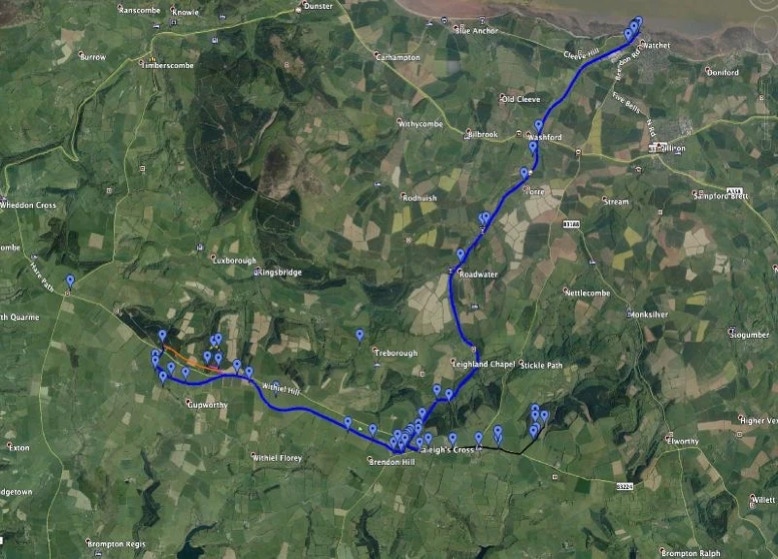
Map of the Old Mineral Line
Brief History.
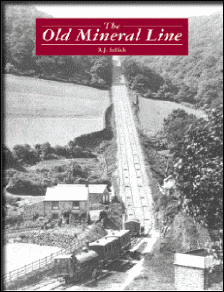
Based on "The Old Mineral Line" by RJ Sellick.Halsgrove press.
Note: Various grants have been obtained for the conservation of various parts of the old line (such as the winding house at Brendon). Conservation work at Langham Engine House and Bearland Ventilation Flue is now complete; these sites will be open by Autumn 2009. The Incline is currently undergoing conservation and access works, keep checking the everythingexmoor website for news about public access. Watchet Market House Museum has benefited from Heritage Lottery funding for a new exhibition and models on the Mineral Line. The Museum is open from 1st April until 31st October.
Links and more information:
A more detailed history plus details of the locos that worked the line see: Wikipedia
SA Lenux has this page with a few B&W pics
This site again has a potted history but also pictures of the incline and colour pictures of the winding house.
This site is still under construction...
This is the 'official' WSMR website and thus carries imporartant information about some of the conservation projects for this old line. It also will give details about potential coach tours in the summer months.
Extra information with links to details and some pictures on stations can be found here (with a potted history and some pics; scroll down to see a list of the other stations.).
RTJ Stevens 10th Jan 2019. V1.43
You should be able to access it by clicking this URL . or the map in the top right-hand side of this page. Google seem to have removed all my photos!
You should be able to navigate, zoom in and out, and, if you click on the place markers (the blue teardrops (sometimes yellow pins in GoogleEarth)) most will give extra detail.
If you find errors or wish to add things please contact me at rtjstevens (at) btopenworld.com
(Substitute "@" for "at)
Iron Ore was probably mined in the Brendon Hills in Roman times, but it wasn't until the Welsh Ebbw Vale Ironworks started looking for nearby sources of iron ore that this railway came into being, at their behest, and (independent) ownership in 1856.
Work started from Watchet to Roadwater (opened May 1857), then onto Comberow at the foot of the Brendon Hills by December 1857. To reach the summit 800ft above a great 3/4 mile incline needed to be built at a gradient of 1:4. Needless to say that at the summit was a steam-driven winding engine. The railway then turned westwards towards the many iron ore mines. Originally the plan was to reach Heath Poult but it only got as far as Gupworthy. There was also a shorter branch to the East (see map above).
To facilitite more efficient offloading of the ore into the waiting ships in Watchet harbour, a new East wall and jetty were built in 1862.
Mining communities obviously sprung up along the East-West corridor and thus passenger services were instigated (although the ascent or descent along the incline was at passenger's own risk (and thus free)). At one point over 250 people lived at Brendon.
Around 1876 there was a recession in the iron and steel trade, and, coupled with cheaper imports of Spanish ore (Spannish grass was being imported into Watchet anyway for the rising Paper Industry there), the mines shut in September 1883.
In 1907 The Somerset Mineral Syndicate was formed to work two of the old mines and to lease the railway line. It bought wagons and an unsatisfactory fomer Metropolitan loco (it was far too heavy - even when its condensing gear was removed), to work as far as Comberow only. The two mines were at Timwood (a new deep tunnel was constructed - but was never worked) and at Colton where a 2ft tramway (really a narrow-guage line) was laid from the top of the incline along the main road towards Galloping Bottom - aptly named as there was another steep inline there necessitating another winding engine. However, there could have been a third pit plus incline much further to the West at Blackland Mine . The whole venture shut in March 1910.
An Australain inventor used the Watchet to Washford stretch to demonstrate a new form of Automatic Train Control in 1912. This was successful but war was looming...
The metals were later requisitioned for the Great War; finally by 1919 there were no rails or rolling stock. The Company was woundup in 1925.
Have you ever tried Geocaching? Want to go on a walk but your young children hate the 'w' word?
Why not dress it up as a TreasureHunt? All you need is a GPS unit, although an OS map and a computer as well can make life a little easier. Visit the website, plug in the area in the world you wish to explore and either view the details OR download it to your Mac (or PC if you're unlucky) and print off the details and/or upload it into free software that will put all the details (inc co-ordinates) into the GPS unit. Off you go to find the 'treasure' (called a cache). Usually one needs to sign the book, take a piece of treasure out and replace if with something of equal value. Then off to the next one. Why not leave a cache for others to find?
(You may need to LogIn as a (free) member to view these).
